
Tension type headache
Treated here
Feels. Both sides. A pressing band, mild to moderate. Scalp and neck muscles tender.
Clues. Not worsened by activity. No vomiting. Builds through the day and lasts hours to days.

Headaches that start in the neck and the base of the skull are common, exhausting and often mistaken for migraine. This page explains how they form, what actually helps, and where doctor delivered Botox fits in.
From £360
per treatment, after an £80 suitability appointment
20 minutes
in clinic, no downtime beyond the day
3 to 4 months
typical duration of effect
Norwich
in person, doctor delivered
Two of the most common headaches we see do not begin in the head at all.
The plumbing, in one sentence
The most common headache in the world. In the occasional form it is largely a muscle problem: the muscles of the scalp, jaw, neck and shoulders are held tight for hours, often without you noticing, and the tissue becomes tender. The pain is felt as a tight band or pressure on both sides of the head.
When it happens on more days than not, the pain pathways in the spinal cord and brain become sensitised. They fire more easily and turn the volume down less well, so ordinary muscle tension is now felt as a headache. This is why frequent tension type headache usually needs more than painkillers.
Here the source is the upper neck itself: the small joints between the top three vertebrae and the deep muscles at the base of the skull. Poor posture, desk work, an old whiplash injury or simple wear irritate these structures, and because their nerves join the head's nerve supply in the brainstem, the pain is referred upwards. It is felt over the back of the head, the temple or behind the eye, usually on one side.
There is also a mechanical part. The greater occipital nerve leaves the spine just below the skull and threads through the semispinalis and trapezius muscles on its way to the scalp. When those muscles are chronically tight they squeeze the nerve, producing a sharp or burning pain up the back of the head. This is the part that Botox targets.
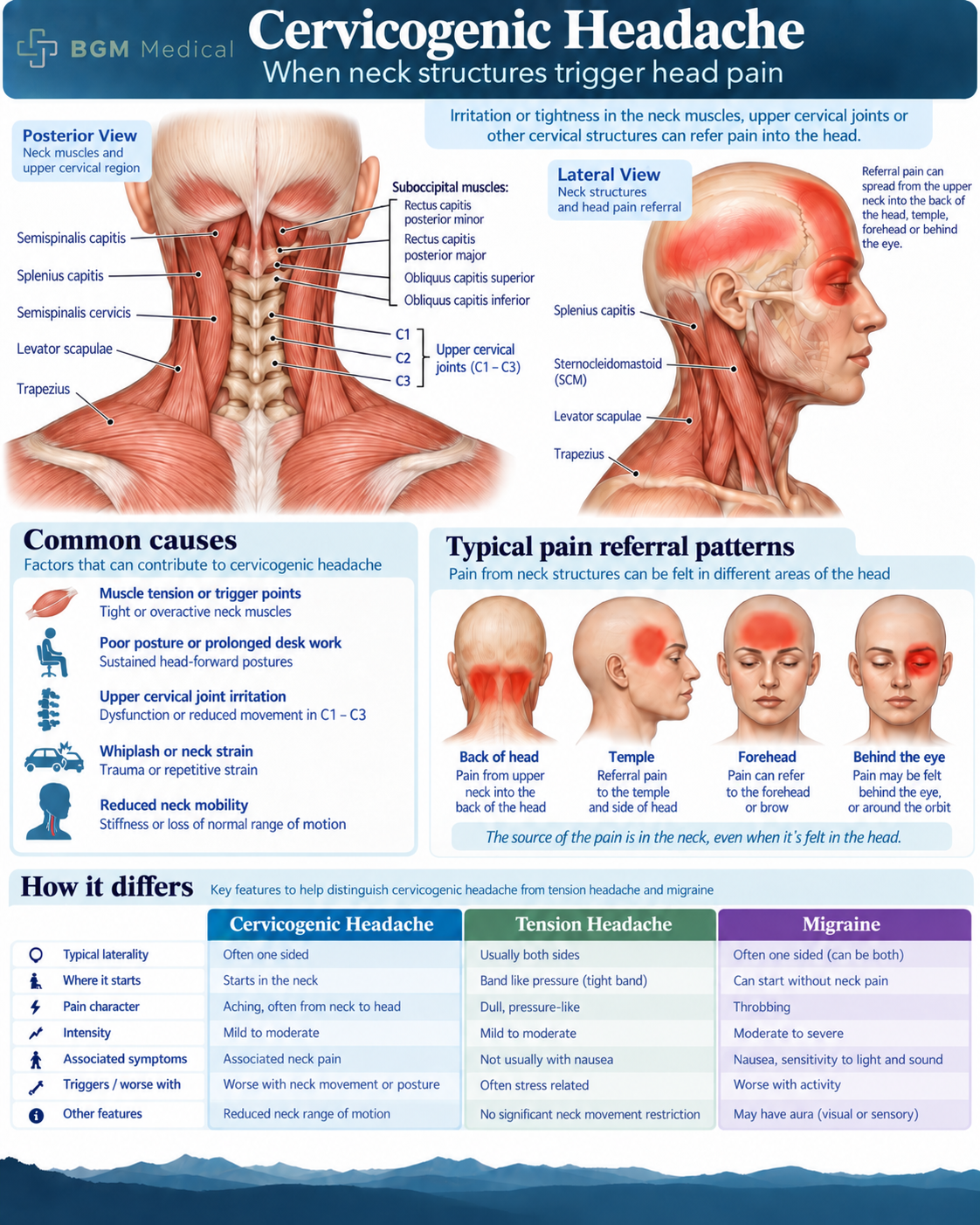
Many people are told they have migraine when the pattern fits a neck driven headache, and the reverse also happens. The label matters because the treatments differ.
Treated here
Feels. Both sides. A pressing band, mild to moderate. Scalp and neck muscles tender.
Clues. Not worsened by activity. No vomiting. Builds through the day and lasts hours to days.
Treated here
Feels. One side, and stays on that side. Starts at the base of the skull and spreads forward, sometimes to behind the eye.
Clues. Worse with neck movement or long periods at a desk. Pressing the upper neck reproduces the head pain.
Feels. Often one side. Throbbing, moderate to severe. Nausea and sensitivity to light and sound.
Clues. Attacks of 4 to 72 hours, worse with activity. Chronic migraine is 15 or more headache days a month, and Botox has good evidence here.
Feels. Strictly one side around the eye. Excruciating. Red watery eye and drooping lid on that side.
Clues. Short attacks at the same time each day for weeks. Needs specialist care.
Feels. Dull, daily or near daily, never quite gone.
Clues. Painkillers on 10 to 15 or more days a month for over 3 months. Improves once they are withdrawn with support.
Many people have more than one type at once. Chronic migraine is often accompanied by neck pain and muscle tenderness, which is one reason Botox in the neck muscles helps migraine too.
The diagnosis is made from the story and the examination. There is no scan or blood test for these headaches, and imaging is only needed when something does not fit.
Risk factors
Points towards the neck
Points towards migraine
When a headache needs urgent attention
Botox and physiotherapy are for benign headaches. Call 999 for the first two below. See a doctor promptly for the rest.
We work up this ladder, not down it. Botox is one option among several and for many people the earlier steps are enough.
Our position
Screen breaks, monitor at eye level, heat on the neck, hydration, regular sleep, less caffeine and a headache diary.
The foundation in every headache guideline. Low cost, low risk, limited trial data for individual habits.
Daily stretches for the upper trapezius, levator scapulae and suboccipital muscles, deep neck flexor strengthening and regular aerobic exercise.
A six week neck exercise and manual therapy programme cut cervicogenic headache frequency with benefit still present at 12 months (Jull, Spine 2002). Aerobic exercise reduced migraine frequency as well as topiramate did in a Swedish trial.
Assessment of posture and neck movement, hands on treatment of the upper neck and a tailored exercise plan.
Moderate quality evidence for manual therapy plus exercise in cervicogenic headache. More modest but positive for tension type headache. Very low risk.
Ibuprofen, aspirin or paracetamol for occasional episodes. Low dose amitriptyline at night for frequent headache. Migraine has its own preventives.
Simple painkillers help episodic tension type headache modestly (Cochrane). Amitriptyline reduces frequency in chronic tension type headache and migraine (BMJ 2010). Using painkillers on more than 10 to 15 days a month causes medication overuse headache.
Local anaesthetic, sometimes with steroid, injected around the greater occipital nerve at the base of the skull or into tender muscle knots.
Reduces headache days in chronic migraine and gives good short term relief in cervicogenic headache. Relief lasts weeks rather than months.
Small injections of botulinum toxin into the upper trapezius, splenius and suboccipital muscles, with or without steroid, relaxing them for around three months.
Strong for chronic migraine. Mixed for tension type and neck driven headache. Detail below.
The evidence, in short
Chronic migraine
Cervicogenic headache
Episodic tension type headache
Botulinum toxin has been used medically for over 30 years and has a good safety record at these doses. The neck is less forgiving than the face, so we use conservative doses and place injections carefully.
We will not treat you if
Most people, settles within days
A minority, settles within weeks
Reported, very unusual at these doses
It is the same medicine, botulinum toxin type A, injected into different muscles for a different purpose. For headaches it goes into the upper back, neck and base of the skull rather than the face, so it does not change your appearance.
The effect starts within 5 to 14 days, peaks at around 4 to 6 weeks and usually lasts 3 to 4 months. If it helps, treatments are typically repeated every 12 weeks.
The honest answer is that the evidence is mixed. Botox has strong evidence for chronic migraine. For tension type and neck driven headaches some people get excellent relief and others notice little change. We recommend stretching, physiotherapy and simple medication first and will tell you plainly if we do not think Botox is likely to help.
A headache that starts in the neck. The upper neck joints, muscles and nerves share a relay station in the brainstem with the nerve that supplies the head, so pain from the neck is felt in the head, often at the back of the skull, the temple or behind the eye. It is usually one sided and worse with neck movement or sustained posture.
No. We add a small dose of steroid with local anaesthetic around the greater occipital nerve when the nerve itself is irritated and tender. Botox alone is used when the problem is mainly muscle tightness. We decide this with you at the suitability appointment.
Treatment is from £360 per session. All procedures need an initial suitability appointment first, which is £80. There is no obligation to go ahead afterwards.
NHS Botox is available for chronic migraine through a specialist headache or neurology clinic once at least three preventive medications have failed, in line with NICE guidance. It is not routinely available on the NHS for tension type or cervicogenic headache.
A GMC registered doctor at our Norwich clinic. This is an in person procedure and cannot be done remotely.
Sources
£80, in person in Norwich. A doctor takes your history, examines your neck and tells you honestly whether Botox, physiotherapy, medication or something else is the right next step. No obligation to go ahead.