
Consent Policy
Your right to understand, decide, ask questions, and change your mind
Plain-language summary
- We will ask for your consent before providing care, treatment, procedures, prescriptions, photography, or sharing information.
- Consent must be your choice, based on clear information, and given by someone able to make that particular decision.
- We will explain the benefits, important risks, alternatives, costs where relevant, and what may happen if you decide not to proceed.
- You can ask questions, request information in a more accessible format, take time to decide, or change your mind before treatment.
- A consent form supports the conversation—it does not replace a proper discussion with your clinician.
- If someone may have difficulty making a decision, we will first do everything practical to support them and follow the Mental Capacity Act 2005 where applicable.
What consent means for you
Your decision
Consent must be voluntary, informed, specific, and given by someone with capacity or other lawful authority.
A conversation
We will share relevant information, check your understanding, and give you the opportunity to ask questions.
An ongoing process
Consent is not a one-off signature. You may reconsider or withdraw it before treatment.
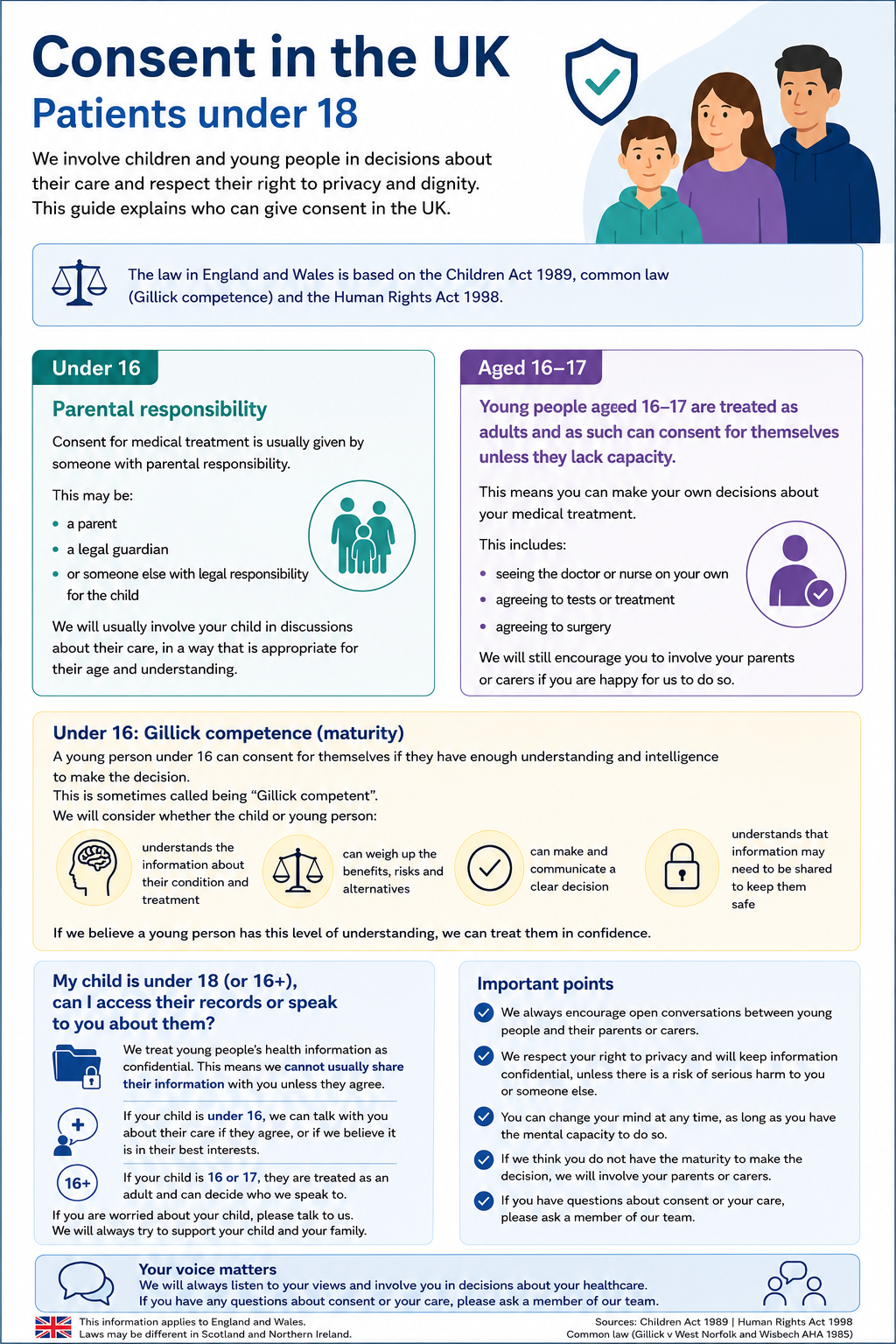
Consent for children and young people
We see children and young people only for low-risk presentations within our service scope, where there are no safeguarding concerns and a safety-netting plan is in place. Competence and consent are considered for the individual child and the specific decision—not treated as a general status.
People aged 16 or 17 are generally presumed able to consent to their own treatment. For someone under 16, we assess whether they have enough maturity and understanding to make the particular decision (often called Gillick competence). Otherwise, consent is sought from someone with parental responsibility. If there is uncertainty about consent, competence, capacity, or safeguarding, the consultation will not proceed until the case has been discussed with the Safeguarding Lead.
Read our Consent Policy and Procedure
Consent Policy and Procedure
Our formal policy
Purpose
To ensure that valid consent is obtained and documented before care, treatment, photography, procedures, prescribing, or information sharing takes place.
Scope
This policy applies to all consultations, procedures, prescribing decisions, photography, remote appointments, and any related care or treatment delivered by the service.
Policy statement
BGM Health Limited will obtain and document consent that is voluntary, informed, specific, and given by a person with capacity, or by a lawful decision-maker where applicable. Consent is a process rather than a single form. Clinicians will support understanding, answer questions, and ensure patients can withdraw consent at any time before treatment.
Responsibilities
- Clinicians assess capacity, provide sufficient information, check understanding, answer questions, and document consent appropriately.
- The Clinical Lead ensures that consent documentation and procedures remain aligned with law, professional standards, and the service scope.
- Staff involved in booking, triage, or administration must not present forms as a substitute for clinical discussion where clinical consent is required.
Procedure and standards
Information provision
We will explain the nature and purpose of the care, expected benefits, realistic alternatives, material risks, likely aftercare, relevant costs, and the limits of remote care.
Forms of consent
Written consent is used for procedures, minor surgery, photography, and other interventions where a signed record is appropriate. Digital consent may be obtained through our secure clinical platform. Verbal consent may be appropriate for low-risk consultations and will be recorded in your notes.
Withdrawal of consent
You may withdraw consent at any point before treatment or treatment is supplied. We will respect and document your decision.
Capacity
Where there is doubt, capacity will be assessed under the Mental Capacity Act 2005 by considering whether the person can understand, retain, weigh, and communicate the relevant decision.
Supporting decisions
Before concluding that someone lacks capacity, we will take practical steps to help them decide. This may include accessible information, extra time, an interpreter, or—with their agreement—a trusted family member or carer.
Advocacy and representation
Where appropriate, we will consider an Independent Mental Capacity Advocate. The authority of any health and welfare attorney or court-appointed deputy will be checked and documented.
Remote consent
For remote care, an online screening form is followed by a clinician-led telephone or video consultation. The clinician must check understanding and provide an opportunity to ask questions before treatment is agreed.
The Mental Capacity Act 2005: five principles
- A person is assumed to have capacity unless it is established that they lack it.
- A person must receive all practical help to make a decision before being treated as unable to decide.
- A person is not treated as unable to decide merely because they make an unwise decision.
- Any act or decision made for someone who lacks capacity must be in their best interests.
- The decision-maker must consider whether the purpose can be achieved in a less restrictive way.
If a patient lacks capacity, treatment will not proceed unless delaying it would itself cause harm and the decision is limited to low-risk continuation of previously agreed care. Any exception must be discussed with the Clinical Lead, fully documented, and remain within legal and professional boundaries.
Monitoring and assurance
Records will be audited for consent documentation, including procedure-specific risks, alternatives, and any withdrawal or limitation. Related complaints, incidents, and feedback will be reviewed through governance processes.
Review
This policy will be reviewed annually or sooner if relevant legal or professional guidance changes.
Independent information about consent
A patient-friendly overview of valid consent, how it is given, and when it may not be required.
NHS: Children and young peopleConsent, parental responsibility, and Gillick competence for people under 18.
GOV.UK: Mental Capacity ActThe official Code of Practice for decisions made under the Mental Capacity Act 2005.
GMC: Decision making and consentProfessional guidance explaining shared decision-making and informed consent.