contact@bgm-medical.com
ADHD Assessment & Management

You are not broken. Your brain just works differently.

We know the struggle. We have been there. And thankfully, it is becoming more normal to talk about it. Getting answers changes lives.

C

A note from Dr Chris

“I have ADHD myself, so this is something I understand from both sides. Before my own assessment, I remember someone telling me that starting ADHD medication had been life-changing for them. I remember thinking that it probably wouldn't make that much difference. It was only after my own diagnosis that I realised quite how much ADHD had been affecting me day to day, often in ways I hadn't fully appreciated at the time.

Going through that process also made me aware of something else. There is a lot of conversation around neurodiversity at the moment, and understandably so, but there is also a lot of lip service. Many people describe themselves as 'specialists', but having been through it myself and having worked with different services, I know that genuinely understanding neurodiversity is something quite different. It is nuanced and deeply personal, and when it's done properly, it makes a huge difference.

We don't want to promise the world, but I do believe strongly in getting this right. ADHD, when understood and supported properly, can be a real strength and superpower. The aim isn't to change who someone is, but to help them understand how they work and give them the tools to use that to their advantage.”


Understanding ADHD

What actually is ADHD?

In plain language. No jargon, no shame.

The brain chemistry bit

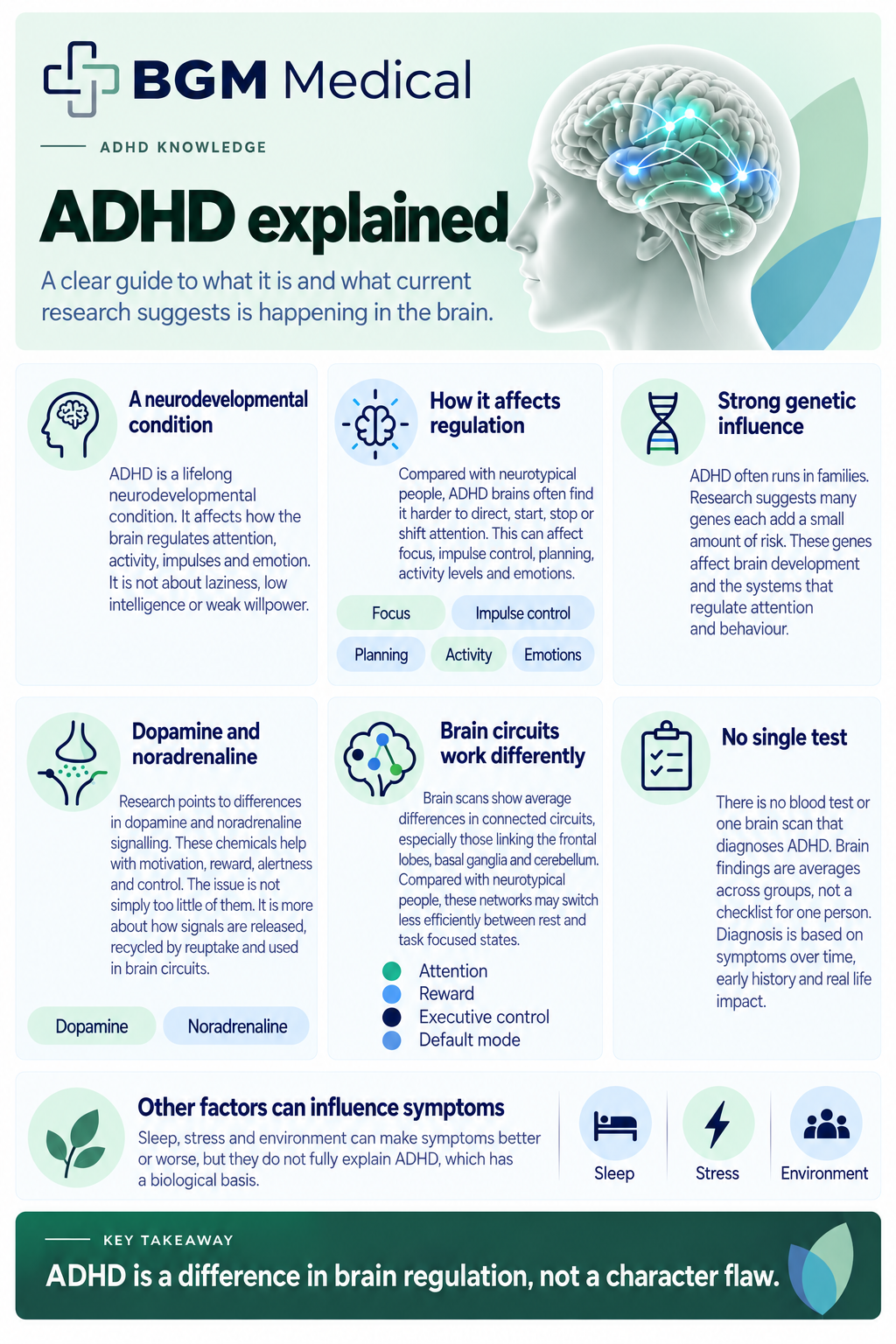
ADHD is a neurodevelopmental condition that affects around 5 to 8% of people. At its core, it involves differences in how dopamine and norepinephrine, the brain's key 'focus and reward' chemicals, work. The brain is not broken; it is tuned differently. It often struggles in environments designed for people whose brains reward sustained attention to things they don't find inherently interesting. For many people with ADHD, this means enormous effort to do things others find automatic.

It's not about intelligence or effort

ADHD has nothing to do with how clever you are. Some of the most creative, innovative, and successful people in the world are neurodivergent. The challenge is that much of the world, workplaces, schools, healthcare, is designed around neurotypical brains. Many people with ADHD have spent years trying to fit that mould and wondering why it feels so hard. It is not a character flaw. It is brain biology.

ADHD looks different in different people

We used to think ADHD was primarily a condition affecting hyperactive young boys. We now know that is a very limited view. ADHD presents differently across genders, ages, and individuals. In women and girls, it often presents with more internalised symptoms: anxiety, people-pleasing, exhaustion from masking. Many adults, particularly women, reach their 30s or 40s before getting a diagnosis. The struggles were real all along.

What causes it?

ADHD has one of the strongest genetic links of any condition. If a parent has ADHD, their child has roughly a 50% chance of having it too. Environment also plays a role, but it is not caused by bad parenting, too much screen time, or sugar. It is a difference in brain wiring that you are likely born with. It may have gone unrecognised for years, particularly if you have developed strong coping strategies (known as masking) to get by.

The Assessment Process

What to expect

Our assessments have no fixed time limit. We take as long as is needed to do a thorough and fair assessment. We aim to complete yours within 1 week of your request.

01

Request & intake

Fill in our short intake form online. We will review it and confirm your assessment, usually within 24 hours.

02

Screening

Before the full assessment we send you a validated screening tool that looks at the likelihood of you having ADHD. This often also involves sending short questionnaires to family members or people who have known you since childhood, as their perspective can be really valuable. We review the results with you honestly. If the screening suggests ADHD is unlikely, we will tell you that. It may not be worth proceeding to a full assessment, but if you want to we are absolutely happy to continue. Our priority is making sure a full assessment is the right next step for you. If you choose not to proceed, the screening fee is £300.

03

The assessment

A thorough, unhurried clinical interview with no time limit. We explore your current symptoms, history, and how ADHD (if present) is affecting your life.

04

Collateral history (if helpful)

Sometimes it helps to speak to a family member or partner who knew you as a child. This is optional and we will discuss it with you.

05

Outcome & report

We will discuss the findings with you, provide a formal diagnostic letter, and a letter for your GP. All included in the assessment fee.

06

Management discussion

Whether or not a diagnosis is made, we will discuss all your management options, from lifestyle strategies to medication and coaching.

“At BGM Medical, we aim to complete assessments within a week of your request. That isn't about rushing or cutting corners, it's about recognising how important it is not to leave people waiting when they're trying to make sense of things.”

Dr Chris
Pricing

Transparent, all-in pricing

No surprises. Drug costs are always charged separately and we will always discuss the most cost-effective options with you.

Adolescent (16 to 17)

ADHD Assessment

£1,300

  • No time limit, as long as needed
  • Full diagnostic interview
  • Discussion of management options
  • 1 formal letter confirming diagnosis
  • Letter to your GP
  • Aim: completed within 1 week of request
Follow up appointment£280
Prescription£10 per prescription
Letter / form£30 per item

Adolescent Package: £3,000

  • Up to 3 letters or reports
  • Unlimited follow-up appointments
  • Prescribing costs included (medications still carry a cost)
  • Free NAP-10 (Neurodiversity Assessment Profile)
  • 1 free mentoring session
  • 25% off your first 2 neurodiversity coaching sessions
Request assessment
Adult

ADHD Assessment

£985

  • No time limit, as long as needed
  • Full diagnostic interview
  • Discussion of management options
  • 1 formal letter confirming diagnosis
  • Letter to your GP
  • Aim: completed within 1 week of request
Follow up / annual review£200
Letter / form£40 per item
Neurodiversity coaching£100/hr
Neurodiversity mentoring£60/hr

Adult Package: £2,000

  • Up to 2 letters or reports
  • Unlimited follow-up appointments
  • Prescribing costs included (medications still carry a cost)
  • 50% off online neurodiversity-specific courses
  • 25% off your first mentoring or coaching session
  • Free 6-month access to NAP-10 and ABI-36
Request assessment

Knowing can be the start of everything

We know how scary a diagnosis like this can feel. But we also know, from personal experience, that understanding what is going on can lead to so much more self-knowledge, self-compassion, and growth. Whether you receive a diagnosis or not, we will help you understand what is happening and what steps make sense for you.

Neurodiversity Coaching

Coaching

Beyond diagnosis, many people find that tailored coaching makes a profound difference. Our online coaching sessions focus on practical strategies for managing day to day life as a neurodivergent person, whether that is organisation, relationships, work, or simply understanding yourself better.

If you want structured goals, measurable progress, and a qualified coach who will challenge you properly, this is our coaching service.

£100 / hr
Neurodiversity Mentoring

A lighter touch

Our mentors are not specialist neurodiversity coaches, but they have genuine lived experience of navigating life alongside neurodiverse people. Sometimes that is exactly what you need. A listening ear, not a lecture. Experience through real life, not just training.

Mentorship is not coaching with the hard bits removed. It is a different kind of useful. If you want structured goals, measurable progress, and a qualified coach who will challenge you properly, that is our coaching service. If you want a real conversation with someone who gets it, this is that.

There is no fixed structure. You do not need to arrive with an agenda. Sessions are conversations. You lead with what is on your mind and we take it from there. We will not sit in silence waiting for you to have an insight, and we will not fill every gap with advice. What we will do is listen properly, ask the occasional thing worth asking, and share what we actually think.

Some people find one or two conversations is all they need. Others come back regularly. There is no contract, no minimum commitment, and no sense that you have failed at mentorship if you stop. You come when it is useful. That is it.

Our mentors include people who are both neurotypical and neurodiverse, including parents, partners, and spouses of neurodiverse individuals, many of whom have been involved in mentoring at a national level.

Pioneering Assessment Tools

Built for neurodiverse people

Standard assessments were designed for neurotypical populations and routinely mischaracterise neurodivergent traits as deficits. Both tools below were developed specifically for neurodiverse people, not adapted from tools designed for everyone else.

Neurodiversity Assessment Profile

NAP-10

We collaborated with a national neurodiversity organisation to develop a specific assessment for people with ADHD. It is based on the latest research, expert opinion, and lived experience. It gives a genuinely meaningful picture of how a neurodiverse mind works, not adapted from tools designed for everyone else.

We are currently in the process of publishing this assessment. We believe it has real potential to change how neurodiversity is understood and supported, in workplaces, educational settings, and healthcare.

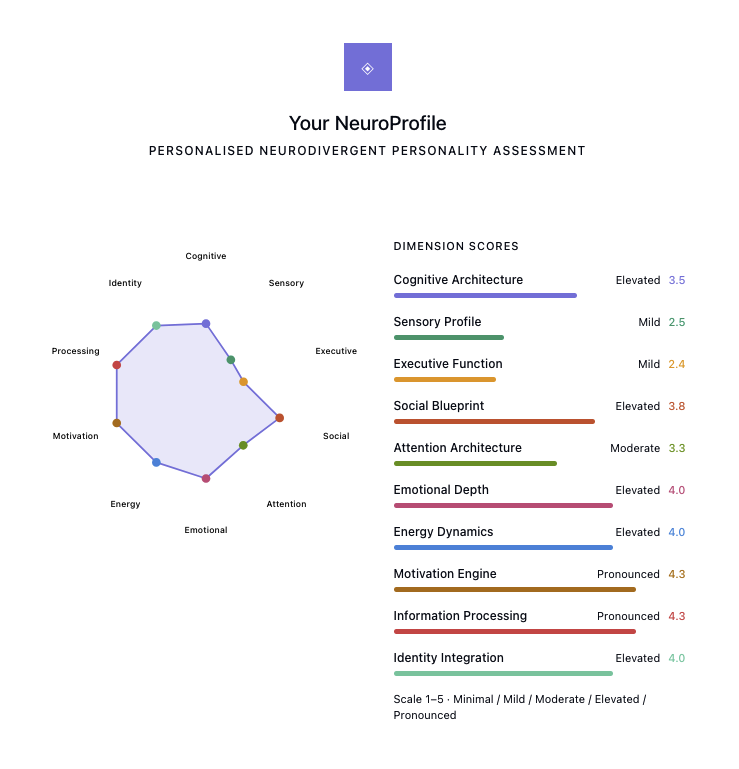
NAP-10 profile summary diagram

The 10 dimensions

01
Cognitive Architecture: Baron-Cohen's E-S theory and Murray, Lesser & Lawson's monotropism model.
02
Sensory Profile: Dunn's Sensory Processing Model and Aron's Highly Sensitive Person research.
03
Executive Function: Barkley's model of EF as a disorder of performance, task initiation gap and time blindness.
04
Social Blueprint: Masking and camouflaging research (Hull, Mandy et al.) and lived experience literature.
05
Attention Architecture: Dodson's interest based nervous system and the spotlight vs floodlight attention model.
06
Emotional Depth: Emotional dysregulation in ADHD (Shaw et al.), alexithymia literature, and polyvagal theory.
07
Energy Dynamics: Spoon theory (Miserandino), autistic burnout research (Raymaker et al.), demand avoidance.
08
Motivation Engine: Interest based vs importance based nervous systems and self-determination theory.
09
Information Processing: Deep processing research, local vs global cognitive style, and flexibility literature.
10
Identity Integration: Late diagnosis research, neurodivergent community belonging, and authenticity frameworks.

What's included

Up to 3 individual assessments per access period
6 months access
Downloadable reports suitable for employers and educational establishments
Included free in any coaching or mentoring session
£50 / 6 months
Get started

ADHD Burnout Identification & Support Profile

ABI-36

Most burnout tools were designed for workplace stress in neurotypical populations. The ABI-36 was built from the ground up for people with ADHD, mapping six dimensions of burnout as they actually present in neurodiverse people, not as an afterthought.

The “36” reflects the total assessment experience: 28 fixed items plus up to 8 adaptive follow up questions that respond to you individually, probing your highest-risk dimensions, exploring prior episodes, and surfacing protective factors. The final report is genuinely personalised, not template driven.

Repeat assessments track the trajectory of your burnout over time, identifying recurring themes, showing what is improving and what is not, and building a longitudinal burnout profile that can inform treatment, coaching, and self-management.

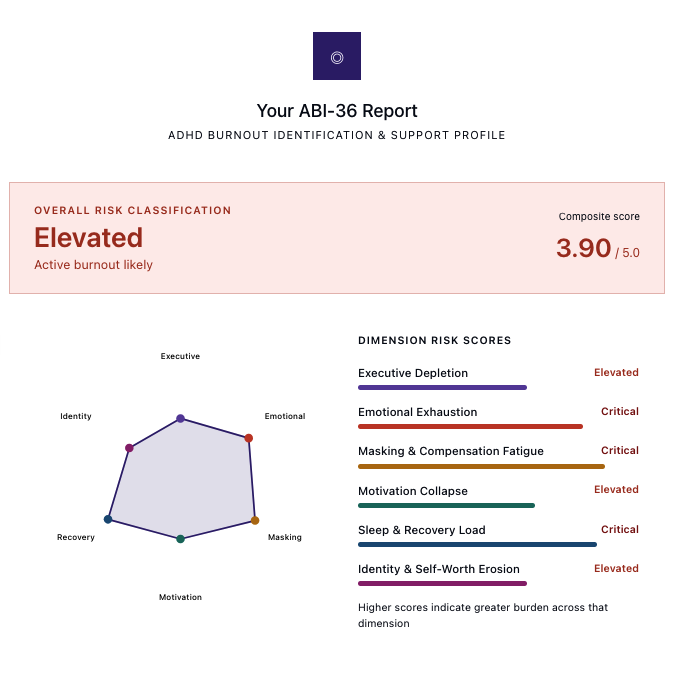
ABI-36 burnout profile summary diagram

The 6 dimensions

01
Executive Depletion: Barkley's EF as performance deficit model; time blindness; initiation gap.
02
Emotional Exhaustion: Dodson's RSD; Brown's emotional cluster; Ramsay & Rostain.
03
Masking & Compensation Fatigue: Young et al.; Mitchell et al.; lived-experience burnout literature.
04
Motivation Collapse: Dodson's interest-based nervous system; dopamine dysregulation.
05
Sleep & Recovery Load: ADHD circadian dysregulation research; Raymaker et al. burnout parallels.
06
Identity & Self Worth Erosion: Hallowell & Ratey; Solanto; shame and imposter research in ADHD.

Five-tier risk model

ProtectiveEmergingDevelopingElevatedCritical

Mapped to Maslach's burnout continuum, adapted for neurodivergent specific presentation.

What's included

28 fixed items + up to 8 adaptive follow up questions
Personalised report, not template driven
Repeat assessments track your burnout trajectory over time
Identifies recurring themes and protective factors
Included free in any coaching or mentoring session
£50 / 6 months
Get started